


About The Program
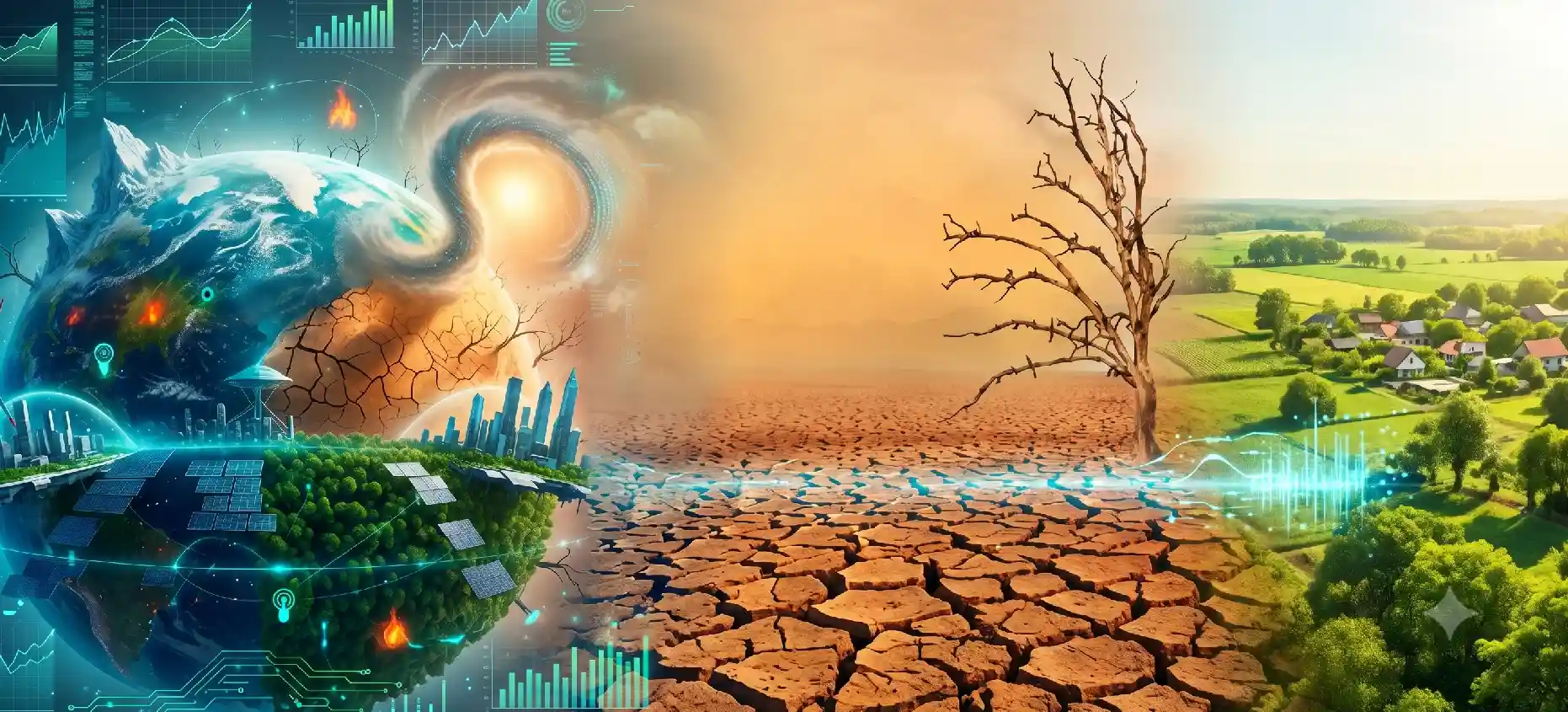
This interdisciplinary master’s program combines climate science, data science, and informatics with policy and sustainability studies. Students will learn to model Earth systems, analyze big environmental datasets, and design data-driven solutions to mitigate and adapt to climate change.
Mission
To equip graduates with advanced scientific knowledge, informatics tools, policy insights, and nature-based solutions to develop data-driven strategies for climate resilience and sustainable environmental management.
Program Objectives
The program is designed to:
- Provide knowledge of climate science, hydrology, and environmental systems in the context of global and regional change.
- Equip students with computational, statistical, and informatics tools for analyzing large-scale climate and environmental data.
- Develop expertise in modeling climate impacts on water, agriculture, ecosystems, and human settlements.
- Integrate policy analysis and governance perspectives into climate and environmental decision-making.
- Promote innovative solutions, including nature-based and technology-driven approaches, for climate adaptation and mitigation.
- To build capacity for evidence-based decision support in government, the private sector, and international organizations, and to conduct interdisciplinary research to generate actionable knowledge for sustainable development.
Program Scope
- Study of climate change processes, variability, and their impacts on the environment and society.
- Application of environmental informatics, including GIS, remote sensing, and spatial and temporal analysis, for climate and environmental assessment.
- Use of machine learning and data-driven methods for climate risk analysis, prediction, and decision support.
Admission Criteria
For admission into an MS in Climate Change and Environmental Informatics (CCEI) program, applicants should have a relevant bachelor’s degree (16 years of education) with a minimum CGPA of 2.0 (in semester system) or 60% (in case of annual system) in the following fields:
Bachelor degree in Environmental Science, Environmental Engineering, Civil Engineering, Agricultural Engineering, Geography, Geology and Earth Sciences, Computer Science, Computer System Engineering, Software Engineering, Telecommunication Engineering, Forestry, Natural Resource Management, Mathematics, Statistics, Architecture, City and Regional Planning, Integrated Water Resources Management (IWRM), Disaster Management, Chemical Engineering & Energy Systems Engineering.
Elective Courses
Students are required to select two elective courses each in the 3rd and 4th semesters from the lists provided below. Electives in the 3rd semester focus on technical, modelling, and analytical skills, while electives in the 4th semester emphasize policy, governance, finance, ethics, and integrative approaches to climate change and environmental informatics.
Scheduling of Courses / Research for MS
| S.No | Course Title | Credits (TH) | Credits (PR) | Course Code |
|---|---|---|---|---|
| First Semester | ||||
| 1 | Geographic Information System and Remote Sensing | 2.0 | 1.0 | CCEI-601 |
| 2 | Professional Development and Practices | 3.0 | 0 | CCEI-602 |
| 3 | Environmental Sciences and Climate Change | 3.0 | 0 | CCEI-603 |
| 4 | Programming for Environmental Data | 2.0 | 1.0 | CCEI-604 |
| Total | 10.0 | 2.0 | ||
| S.No | Course Title | Credits (TH) | Credits (PR) | Course Code |
|---|---|---|---|---|
| Second Semester | ||||
| 1 | Environmental Ecology and Biodiversity Informatics | 3.0 | 0 | CCEI-651 |
| 2 | Machine Learning and Artificial Intelligence in Climate Informatics | 3.0 | 0 | CCEI-652 |
| 3 | IoT-based Techniques in Environmental Monitoring | 3.0 | 0 | CCEI-653 |
| 4 | Environmental Data Science and Big Data Analysis | 2.0 | 1.0 | CCEI-654 |
| Total | 11.0 | 1.0 | ||
| S.No | Course Title | Credits (TH) | Credits (PR) | Course Code |
|---|---|---|---|---|
| Third Semester – (Applied & Technical Focus) Select Any Two Elective Courses | ||||
| 1 | Informatics and Nature-Based Systems | 3.0 | 0 | CCEI-701 |
| 2 | Agro-Informatics and Food Security | 3.0 | 0 | CCEI-702 |
| 3 | Carbon Cycle Modeling and Carbon Accounting Systems | 3.0 | 0 | CCEI-703 |
| 4 | Ecosystem Modeling and Environmental Forecasting | 3.0 | 0 | CCEI-704 |
| 5 | Environmental Physics and Chemistry | 3.0 | 0 | CCEI-705 |
| 6 | Numerical Methods for Environmental and Water Resources Engineering | 3.0 | 0 | CCEI-706 |
| 7 | Statistical and Stochastic Methods in Climate and Environmental Sciences | 3.0 | 0 | CCEI-707 |
| S.No | Course Title | Credits (TH) | Credits (PR) | Course Code |
|---|---|---|---|---|
| Fourth Semester – (Policy, Governance & Integrative Focus) Select Any Two Elective Courses | ||||
| 1 | Environmental Policy, Governance and Climate Negotiations | 3.0 | 0 | CCEI-708 |
| 2 | Risk Assessment and Disaster Management | 3.0 | 0 | CCEI-709 |
| 3 | Energy Systems and Renewable Technologies | 3.0 | 0 | CCEI-710 |
| 4 | Health and Climate Change Informatics | 3.0 | 0 | CCEI-711 |
| 5 | Green Economy and Climate Finance | 3.0 | 0 | CCEI-712 |
| 6 | Climate Ethics and Justice | 3.0 | 0 | CCEI-713 |
| 7 | Water-Energy-Food (WEF) Nexus Informatics | 3.0 | 0 | CCEI-714 |
Program Faculty